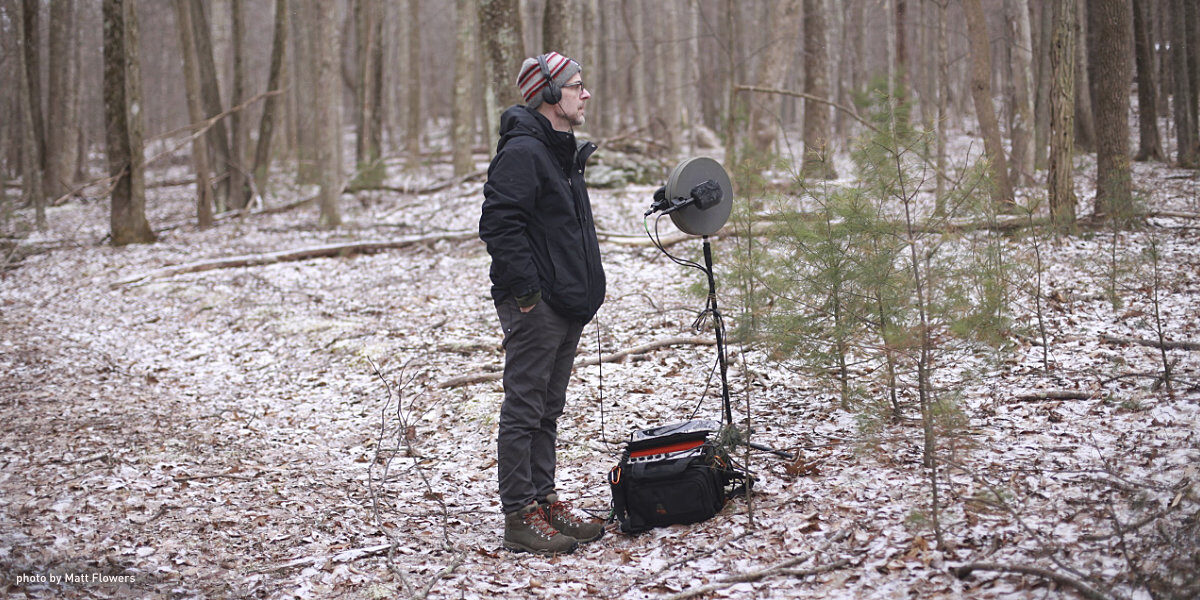
 Stephen Vitiello (photo by Matt Flowers) (
Why?
This assignment is designed to better familiarize you with recording and editing technology and methods, and to further hone your listening skills.
Brief
You will create a one- to three-minute non-musical soundscape to be listened to on headphones using collected and/or generated sounds. This soundscape should loop seamlessly, meaning that the end of the track should perfectly align with the beginning. This soundscape should take full advantage of and explore the stereo field and the frequency range. You will be required to employ at least two prompts (total) from the strategies and methodologies addressed in class: Unstuck, Richard Serra’s Verb List, or Schmidt and Eno’s Oblique Strategies. Describe within your self evaluation which methodologies you used. Also be mindful of the Vocal Viewpoints exercise we did in class as you manipulate and edit your sounds: Tempo, Duration, Repetition, Shape, Gesture, Pitch, Dynamic, Timbre, Silence, Kinesthetic Response
Build your work around a concept. Maybe your concept is documenting a particular space or event. Maybe you are interested in family history, so you collect sounds related to family voices, music, activities, and gatherings. Perhaps you want to think about creating a soundscape to accompany one of your object-based artworks—considering how that artwork might sound, or how sound might augment the experience with that artwork. Your concept may be dealing with the formal aspects of sound, so you should be pushing the sound into interesting areas. Consider where your individual interests lie, and let that guide the sounds you collect and make. Does your concept dictate that the sound will be soft, quiet, and gentle, or loud, aggressive, and dissonant, or will there be a lot of dynamics? Will the sounds be manufactured, collected, natural, or human-made?
You are also required to submit a self-evaluation along with your assignment, so leave enough time to complete the assignment and ruminate on your experience. 10% of your grade is based on your Assessment/Critique—this includes your self-assessment and participating fully in the group critique.
Oversized files should be uploaded to a cloud service like Google Drive, Box, Dropbox, or similar and the link shared on Learning Suite. The file should not be password protected and the student should test the link in an incognito/private browser window to make sure anyone can access it with the link before submitting it.
- Submission Checklist
- Tips and Considerations
- Equipment
- Late Policy
Grading
Assignment grades will be based on the following:
- Conceptual Concerns (40%)
-
Student demonstrates evidence that they understand and inventively integrate conceptual concerns and implications of new genres.
- Excellent: Student demonstrates conversational familiarity with the material—making interesting connections between ideas, readings, and presentations.
- Average: Student is able to recall and recite material, but not do anything interesting with it.
- Below Average: Student struggles to demonstrate a grasp of the material and shows no facility in connecting ideas or new thinking.
- Execution (40%)
-
When executing a project, the student demonstrates a firm grasp of the materials, techniques, hardware, and software. The student’s skills and approach are appropriate to their concept. In written/oral assignments, this includes proper spelling, punctuation, sentence structure, grammar and formatting for written assignments; and annunciation, confidence and focused arguments for oral assignments.
- Excellent: Student displays skills and sensitivity when creating projects. The level of craft and approach to making is appropriate to the concept. In written/oral assignments, student understands writing and presentation modes including style guides and oral confidence and is able to nimbly employ these tools in their art projects, writing, and speaking.
- Average: Student work shows some flaws in their understanding of materials and skills. Stylistic and formatting mistakes are present.
- Below Average: The execution is unconsidered and hasty. Student repeatedly makes the same mistakes and ignores instructor input and suggestions.
- Assessment/Critique (10%)
-
The student will produce a self-evaluation for each art project including the strengths and weaknesses of a given work and plans for future improvement. This will also include an accounting of time taken. The student will also be present for and participate in group critiques of projects.
- Excellent: The student thoughtfully and honestly engages in the self-reflective process of critiquing their own work and efforts. The student enthusiastically engages with group critiques, seeking ways to offer constructive feedback to other students.
- Average: The student performs a cursory and surface-level assessment of their work and efforts. They make neutral comments during the group critiques and do not fully engage.
- Below Average: The student demonstrates an inability to honestly engage with their work as it exists in the world, and does not adequately participate in group critiques, or is absent/tardy.
- Following Instructions (10%)
-
The student adheres to the guidelines provided for the course and the assignment. If the paper has a particular framework, the student adheres to that framework. If an assignment is to be submitted as a Word doc on Learning Suite, the student does not email the instructor a PDF.
- Excellent: A detail-oriented student who takes instruction and fastidiously executes it within their work.
- Average: A student who misses some details because they didn’t read instructions thoroughly or take proper notes when instructions were given.
- Below Average: Student ignores basic instructions and guidance given for assignments.
- On-time Submission
-
Projects lose 5 points (our of 100) per 24-hour period they are late. If an assignment is submitted 5 minutes late, that is within the first 24-hour period, so it loses 5 points. If it is 27 hours late, that puts it in the second 24-hour perdiod, so it loses 10 points. If the assignment is submitted or conducted during class, and you are late to class, you will lose 5 points.
Learning Outcomes Addressed
- Non-Traditional Approaches
-
Students will expand their art practice by engaging in a variety of non-traditional approaches to art production, while incorporating a conceptual framework in their exploration.
- New Genre Art Practices
-
Students will develop a basic understanding of New Genre art practices and their origins, including relevant themes and concerns.
- Production
-
Students will produce a body of work demonstrating a comprehension and engagement with the themes and concepts explored in class.