Table of Contents
Aperture
The dilated series of overlapping plates inside your camera lens that can create different opening sizes for light is called the aperture. The larger the aperture, the more light that is let in. However, the larger the aperture, the shallower the depth of field will be. The aperture is generally measured in “f-stops.”
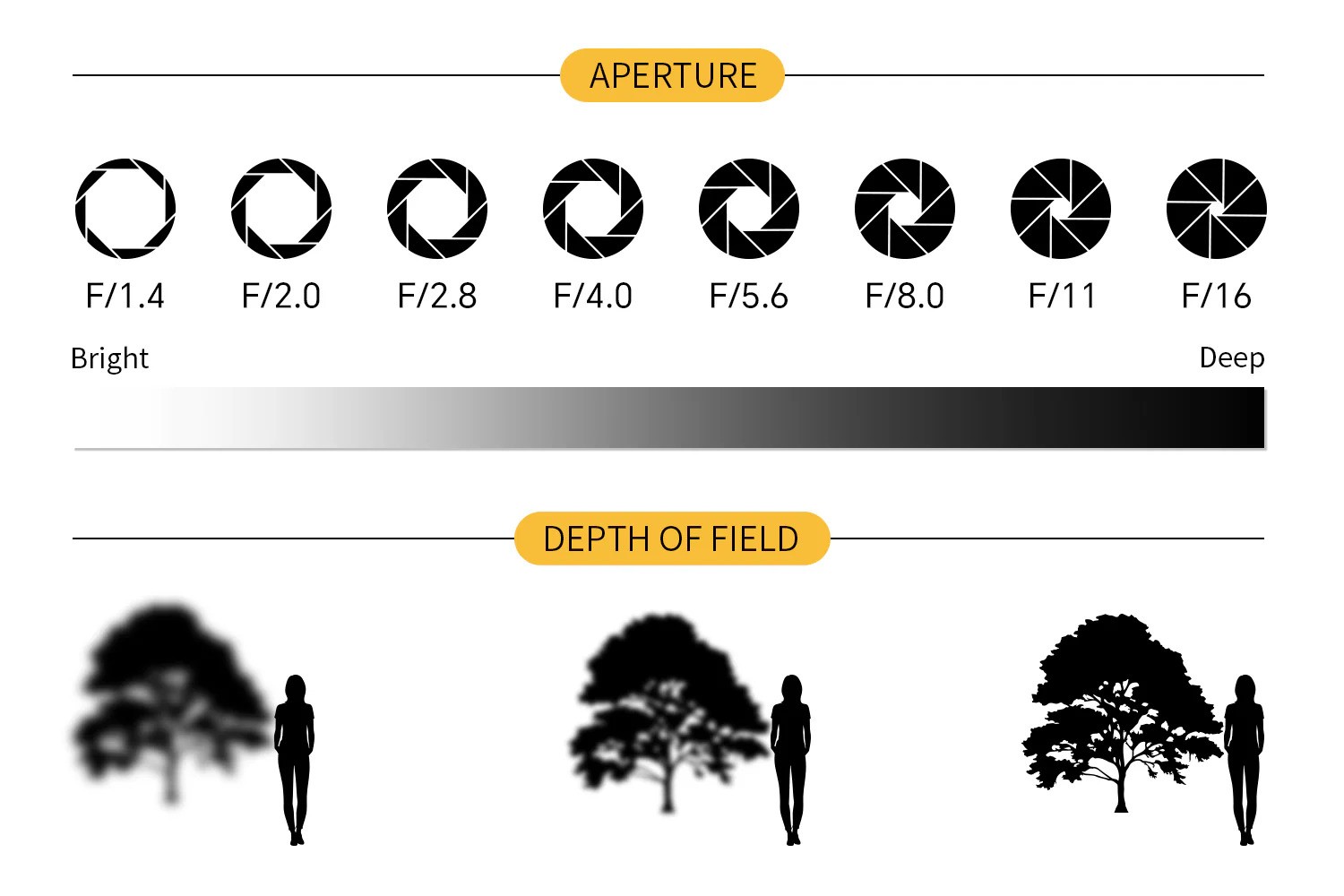
Aperture and depth of field illustrated (source).
Aspect Ratio
The aspect ratio is the proportion of your image frame—derived from factoring the lowest common denominator of the height and width of your image frame. Common camera ratios are as follows:
- 1:1 is a square format, typical for social media, but also older medium-format cameras.
- 3:2 mimics the ratio of traditional 35mm film on full-frame cameras.
- 4:3 is typical for current digital cameras. This is also the same aspect ratio of old cathode-ray tube (CRT) TVs and therefore most old television programs.
- 16:9 is a cinema standard and also used for panoramic landscape photography. Most LED TVs use this ratio, so when you see dimensions such as 1920×1080, that is a 16:9 ratio.
- 2.39:1 is referred to as the Anamorphic widescreen format used in cinema.
- 1.43:1 is the IMAX aspect ratio.
- 2.20:1 is typical for 70mm film used in bigger budget movies.
- 1.618:1 is the golden ratio.
Bokeh
Derived from the Japanese word boke (暈け or ボケ), meaning haze or blur, bokeh refers to the effect in photography when areas of the image are artistically out of focus due to a shallow depth of field. This is typically achieved by using a large aperture with a short focal length lens, rendering the background blurry, while the subject is in sharp focus. This is particularly prevalent in tilt-shift photography.

Tilt-shift photography showing the bokeh effect. Hong Kong viewed from Victoria Peak (source).
Depth of Field
The depth of field (DOF) is the size of the area of your photograph that appears in sharp focus. A shallow depth of field often produces a bokeh effect where the item closest to the camera is in focus, but the items immediately behind the subject are very out of focus. This is often impacted by your lens’s focal length and aperture, and your camera’s sensor size.
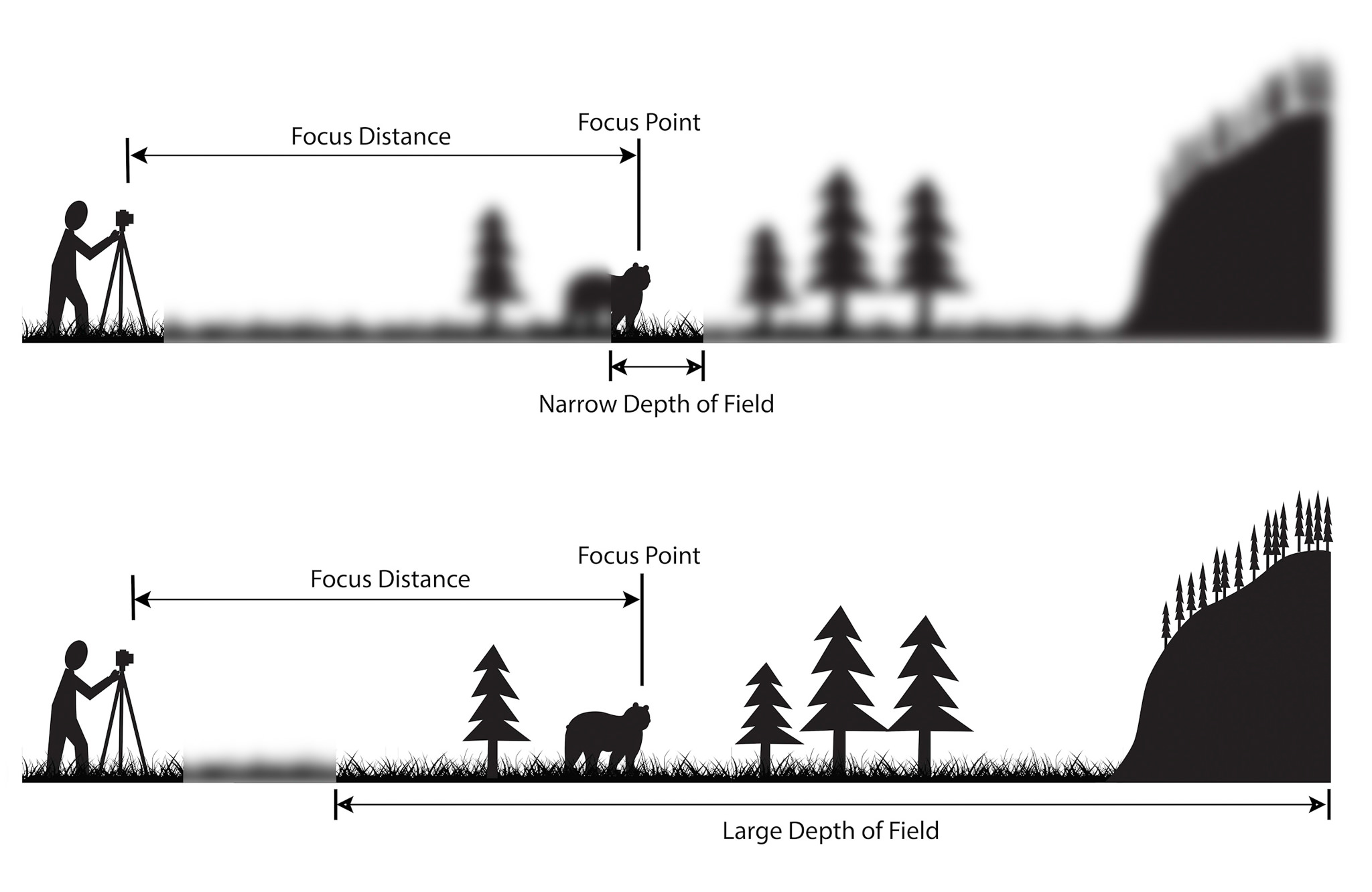
Depth of field (source).
Digital Zoom vs. Optical Zoom
There are two ways to zoom on an image: optically and digitally. Optical zoom is when you use the mechanisms in your physical camera lens to change the distance between lens elements, thereby allowing you to magnify or shrink the image that is projected onto your film/sensor. Digital zoom just involves cropping the information on the screen in different ways, but impacts the resolution of the image. You have probably noticed that when you try to zoom in using your phone, the image becomes very grainy and pixelated. That is because your phone generally has limited optical zoom capabilities, so it falls back to digitally zooming in. It takes a regular image, and then just enlarges a section and crops, but it is not gathering more image information to make it crisp and clean. So, you end up with digital artifacts in your zoomed image.
DSLR
DSLR stands for Digital Single-Lens Reflex and refers to a type of digital camera that utilizes a mirror to capture images. The mirror sits between the lens and the sensor and redirects the light from the lens up to the optical viewfinder (OVF). When the camera takes a picture, it must instantaneously lift the mirror so the light travels from the lens to the sensor behind the mirror rather than being redirected to the viewfinder.
DSLR cameras stand in contrast to mirrorless cameras.
Dynamic Range
According to Adobe:
Dynamic range is the measurement between the maximum and minimum values that can be perceived in an image or video—from the lowest values of density to the highest of luminance. The greater the contrast between the deepest blacks and the brightest whites, the larger the dynamic range.
In photography and video, the term is generally used to talk about the maximum dynamic range a camera can capture.
The greater the dynamic range, the fuller the image and deeper the detail. That’s why a strong dynamic range is essential to any photographer or filmmaker. In scenes with significant contrast between light and dark colours, dynamic range is an important consideration.
Digital cameras are constantly improving and extending their dynamic range – from the minimum to maximum tones they can reproduce. However, digital technology used in photography and video cannot yet perceive the same dynamic range as the human eye.
Exposure
Exposure is the amount of light that reaches the film/sensor, determining how light or dark your image appears. Three main factors impact an image’s exposure: aperture, shutter speed, and ISO. These are referred to as the exposure triangle.
Exposure Triangle
The exposure triangle is made up of the aperture, shutter speed, and ISO and determines the amount of light reaching your film/sensor and the crispness of that image. Adjusting one of these parameters typically means you need to compensate by adjusting the others to reach optimum exposure. For example, increasing the aperture size lets in more light, so the shutter speed can be reduced (to let in less light) and/or the ISO can be lowered (less light-sensitive). This triangle is important to remember as you seek to create crisp and appropriately exposed images in the right situations.
For example, if you are trying to catch a quickly moving object like a car without any motion blur, you will need a fast shutter speed so it only captures an instance. This means less light is coming in, so you will need to increase your aperture (lower the f-stop) to let in more light and/or increase the ISO (thereby possibly resulting in a grainier image) to make it more light-sensitive. If you wanted motion blur, you can increase the shutter speed and decrease the other two.
If you are shooting at night, and trying to photograph the stars that are not moving quickly, you can have a much slower shutter speed and larger aperture, meaning you can keep you ISO low so the image doesn’t become grainy.
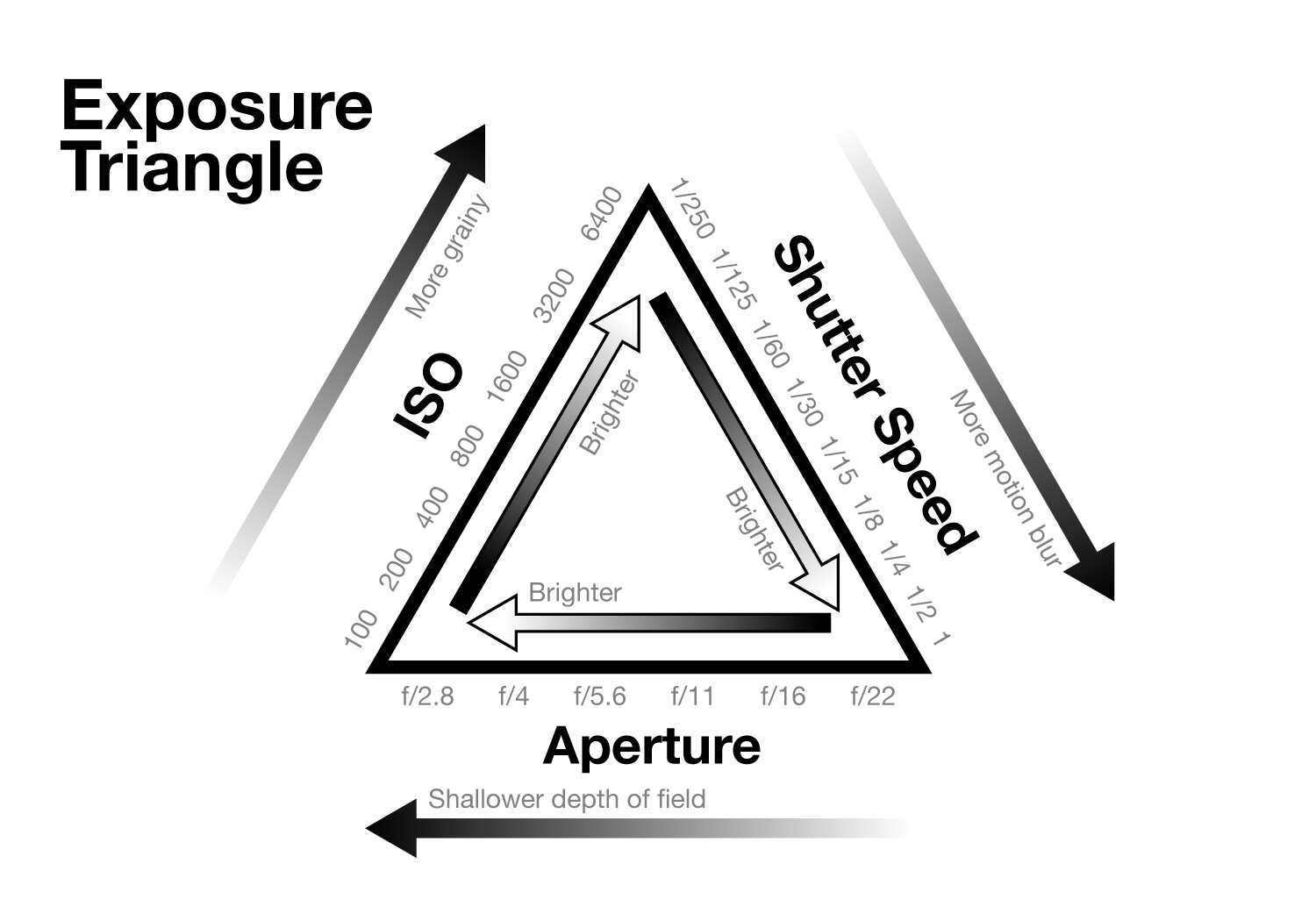
Exposure triangle
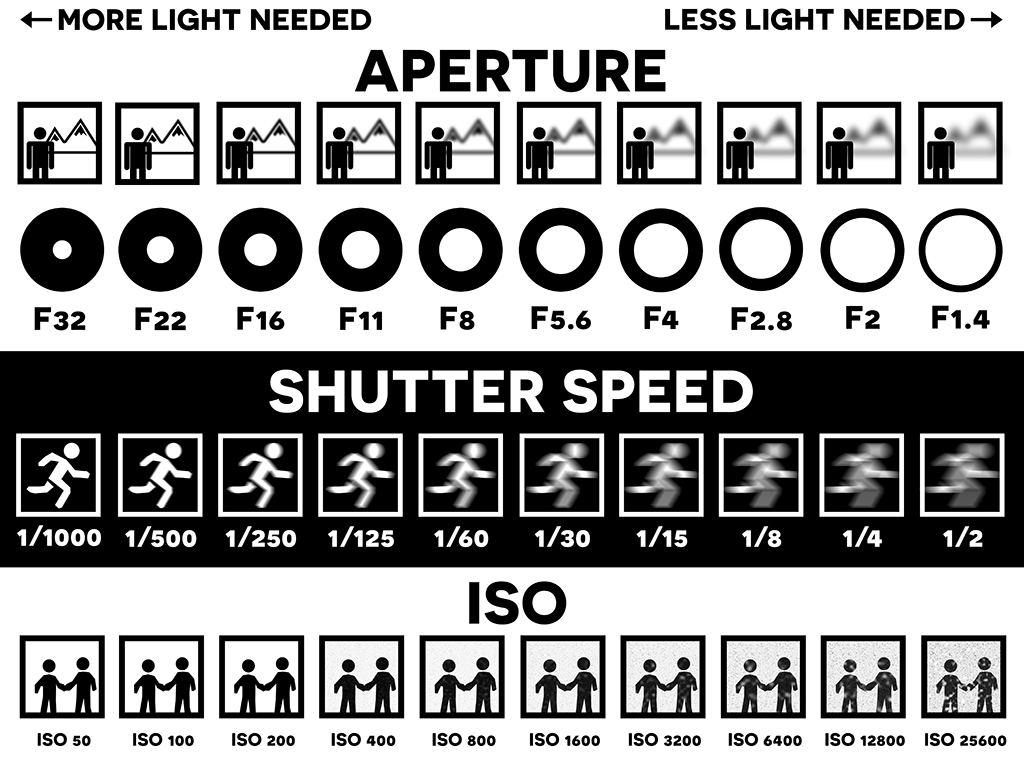
Exposure triangle (source).
F-Stop
F-stop refers to the size of the aperture opening of a camera lens. The “F” in f-stop refers to the “focal length” of the lens which impacts the depth of field. The f-stop is expressed as a fraction, with the “F” as the numerator, and the f-stop number as the denominator: f/1.2 or f/6, for example. As a fraction, this means that the smaller the denominator, the larger the fraction (1/2 is larger than 1/10), so f/1.2 results in a larger aperture than f/6, thereby letting in more light, but resulting in a shallower depth of field.
For example, say that you have an 28–70mm f/3.5–5.6 lens fully zoomed out to 70mm. If your f-stop is set to f/3.5, the diameter of the aperture will be 20 millimeters across (70mm / 3.5), whereas at f/5.6, the diameter will be reduced to 12.5 millimeters (70mm / 5.6).
Focal Length
A lens’s focal length is the optical distance (measured in millimeters) from the point where the light meets inside the camera after being bent by the glass lens unit(s) to the camera’s sensor or film at the back of the camera body. A long focal length will give you a narrower field of view, and a shorter focal length will provide a wider field of view. The shorter the focal length, the farther away the subject may appear, whereas longer focal lengths are zoom lenses and tend to bring subjects visually closer. Longer focal lengths are are generally for shooting things at a distance—wildlife, sports, etc., whereas shorter focal lengths are best for closer photography—portraits, artwork, room interiors, etc.
Lenses from 14 to 35mm are considered wide-angle because of their short focal length and therefore wider field of view, often start resulting in a fisheye distortion of the image. 35–55mm lenses are considered standard focal lengths. 50–55m lenses are typical for portrait photography since they do not distort the subject as much–see portrait image below. 60–200mm lenses are considered telephoto and have a more narrow field of view. 200mm or longer are ultra-telephoto zoom lenses.
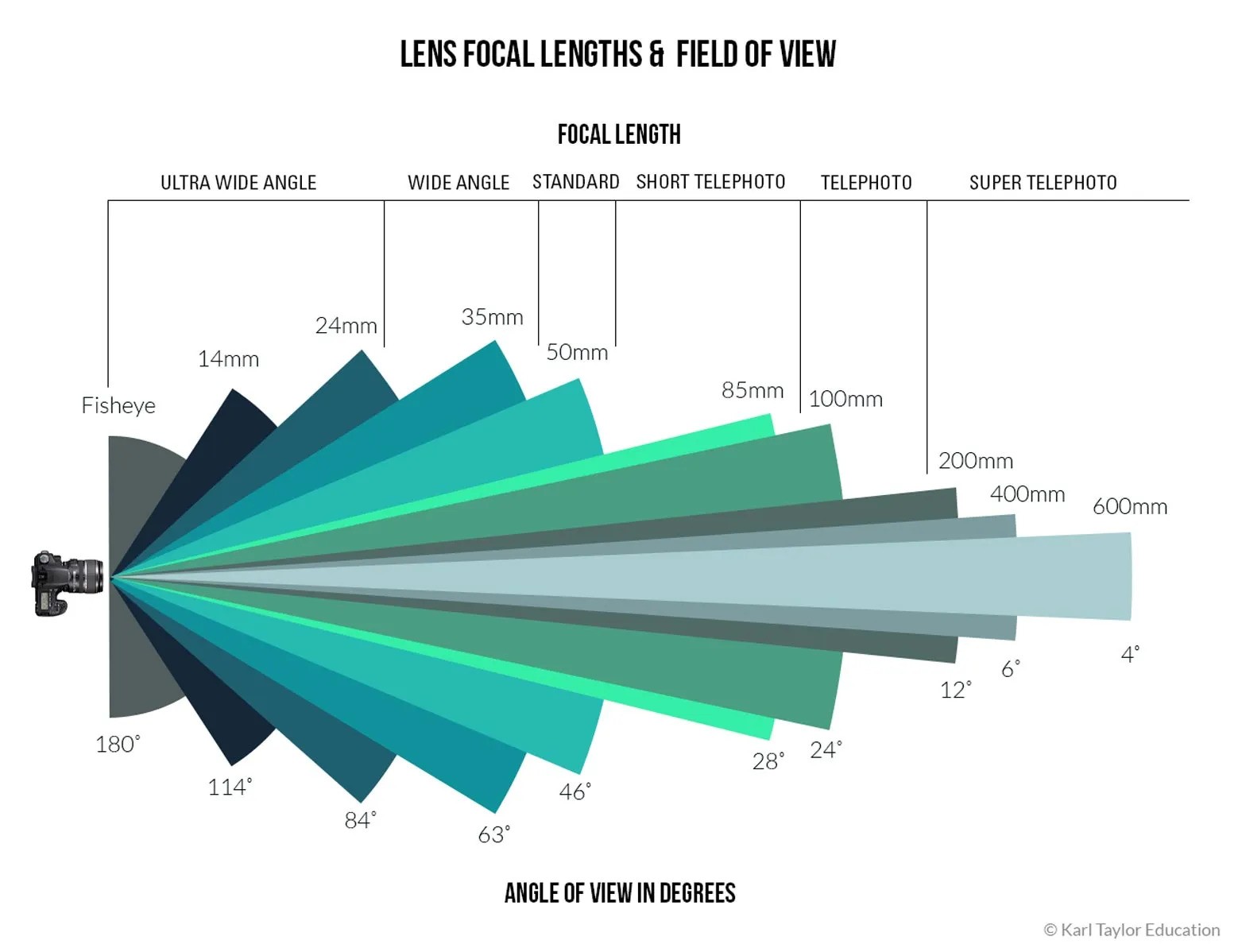
Lens focal lengths and field of view (source).
The focal length and resulting field of view also impacts things like how a face will appear in portraiture. A shorter focal length will make noses look larger and closer, and will make ears and hair look narrower and farther away (the fisheye effect). A longer focal length will flatten and widen the face. To make the image below, the photographer would have had to reposition the camera so the subject appears the same size. The longer the focal length, the farther away the camera will have to be placed to appear the same as a 20mm lens since longer focal lengths are zooming in on the subject.
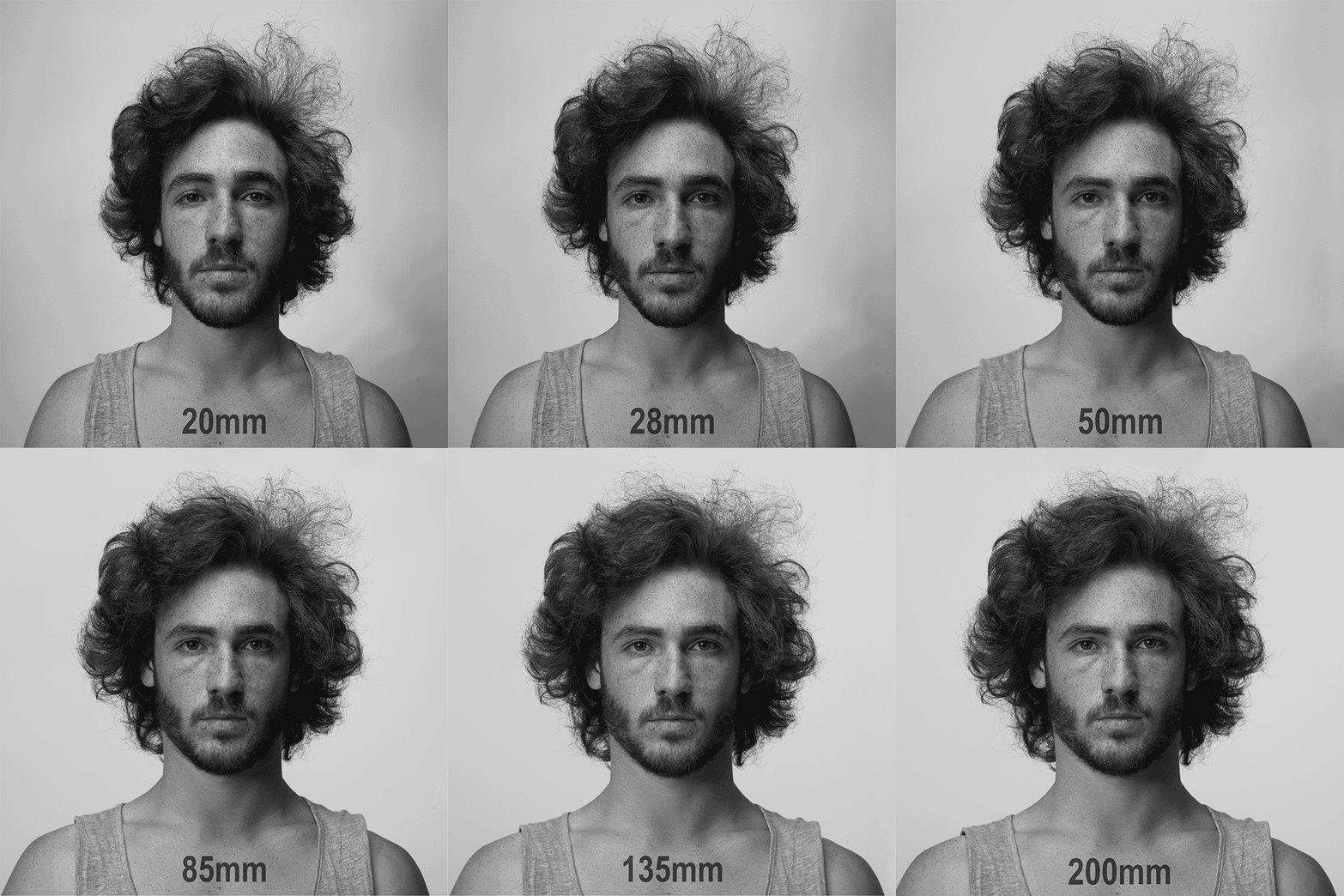
Focal length and the resulting facial distortions: 20–200mm (source).
Frame Rate
Frame rate refers to how many images comprise one second of video or film—this is sometimes referred to as frames per second (FPS). Standard frame rates are as follows:
- 24: This has long been the standard since the early days of film and our eyes are trained to expect this. You will sometimes see a 23.976 frame rate, which is a compensation when film is transferred to NTSC video for broadcast television and DVDs. This provides a more cinematic feel to video.
- 30: This is often used for live broadcasts like news, concerts, and sports as it provides a smoother viewing experience. This gets dropped to 29.97 fps for NTSC use.
- 60: This is typical for high-action sequences, video games, and car racing that demands a high level of detail and minimal motion blur.
For the relationship between frame rate and shutter speed, see the entry for shutter speed below.
Hot Shoe
The top of most DSLR cameras, just above the optical viewfinder (OVF), is equipped with a hot shoe. These are mounting brackets meant for external microphones and flashes. It is called “hot” because it is linked electronically to the workings of the camera allowing things like flashes to be triggered simultaneously when the shutter is released. Mounting brackets without an electrical connection are called “cold shoes.”
ISO
The term ISO comes from the International Organization for Standardization, which is a group that sets the standards for film and camera sensor sensitivity. This global group’s name would have different acronyms in different languages, so they opted to reference the Greek word isos meaning “equal” when referring to their organization, thereby calling it “ISO.”
ISO scales go from lower numbers (less light-sensitive) to higher (more light-sensitive). Lower ISO ratings of film, or lower ISO settings on digital cameras result in images that are finer grained, sharper, and more saturated. Higher ISO rated film/settings provide images that are coarser grained, softer, and less saturated. ISO is sometimes referred to as “film speed” indicating how you might correlate your shutter speed with the film. A high ISO film/setting such as 1600 means that it is very light-sensitive and therefore you can have very fast shutter speeds (letting in less light, but the film/sensor captures that information quickly) to capture motion. So, that would be considered a high-speed film/setting. You can also use high-speed film for low-light settings to capture more light as the film is more light-sensitive.
According to Adobe:
ISO 100: This is the best choice for shooting outdoors on sunny days — the brightest situation you’ll likely be shooting in.
ISO 400: When the lighting is still good, but less intense — like indoors by a window or outside on a cloudy day — a slightly higher ISO is ideal.
ISO 800: If you’re shooting indoors without an additional light source like a flash, you’ll be working in this range.
ISO 1600: When it’s dark out, or if you’re shooting indoors with dim lighting, you’ll need a high ISO. If movement is involved, you’ll want to pair that high ISO with a fast shutter speed as well.
“When the sun is bright outdoors, I barely adjust ISO,” photographer Ivy Chen says. “But when the sun is setting or I’m shooting inside and light conditions change, I’ll start upping my ISO to keep my photos properly exposed.” And while this guide gives you a good start, understanding ISO will be greatly informed by how you adapt while shooting.
Megapixel
This is a unit of measurement often associated with digital camera sensor resolution wherein one megapixel equals one million pixels. It is typically abbreviated to MP. The Fuji X-T4’s sensor can receive and produce a 6240×4160 pixel image. 6240 multiplied by 4160 will give us the total number of pixels within the image: 25,958,400. Rather than write out that full number, we refer to it in terms of megapixels. So, the X-T4’s resolution is about 26 megapixels, or 25.9 MP.
How many megapixels do you need? As many as you can get. In reality, it depends on your final output. If you are just going to be printing 4×6 in. photographs, you don’t need at 25 MP camera. Consider that most photo printing is done at 300 dpi (dots per inch). So a 6000×4000 px image at 300 dpi could be printed up to 20×13.3 inches without a loss of resolution (6000/300 = 20 and 4000/300 = 13.3). The larger you need to print, the higher resolution you will want from your camera.
Mirrorless
Mirroless cameras lack a mirror that redirects light from the lens up to the optical viewfinder (OVF). Instead, they have electronic viewfinders (EVF) or they just put the viewfinder up on the large screen at the back of the camera. Mirrorless cameras tend to be a bit smaller than traditional DSLR cameras, but have larger sensors. They are capable of taking faster photographs since the cameras do not need to lift the mirror to snap a pic.
NTSC
NTSC stands for National Television Standards Committee, which set the standards for television broadcast and related products. It was an analog color-encoding video system used from broadcast television and DVDs. It was used by the Americas (except Argentina, Brazil, Paraguay, and Uruguay), Myanmar, South Korea, Taiwan, Philippines, Japan, and some Pacific Islands. It employed 29.97 frames per second and 4.2 MHz video bandwidth. With the advent of digital television and more advanced digital streaming, Blu-rays, and other products, NTSC has fallen out of favor. you may still see it as a formatting option when exporting videos.
In contrast, much of Europe, Africa, and other countries have use PAL formatting. Videos encoded as PAL cannot be played on NTSC players and vice versa. So, these encoding formats are also a way to enforce international copyright and licensing deals.
PAL
PAL (Phase Alternating Line) is another color-encoding video formatting system television, DVD, and Blu-ray. The PAL format was meant to deal with the flaws of NTSC, including signal issues during poor weather. PAL was employed in Western Europe, China, India, Australia, and most of Africa. Videos encoded as PAL cannot be played on NTSC players and vice versa. So, these encoding formats are also a way to enforce international copyright and licensing deals.
Prime Lens
A prime lens refers to a lens that has a fixed (non-adjustable) focal length, so you may not zoom in and out. These more specialized lenses have fewer internal mechanisms dedicated to adjusting the focal length, so they allow for a greater aperture range. In theory, these have superior image quality with sharper details, but that depends on the build quality of the lens as well.
Resolution
Resolution refers to the number of pixels a digital camera can capture. The Fuji X-T4’s sensor can receive and produce a 6240×4160 pixel image. 6240 multiplied by 4160 will give us the total number of pixels within the image: 25,958,400. Rather than write out that full number, we refer to it in terms of megapixelsa>. So, the X-T4’s resolution is about 26 megapixels, or 25.9 MP. The higher the resolution, the more detailed the resulting images can be at larger formats.
Sensor Format
This refers to the dimensions of the sensor of cameras (which also indicates its aspect ratio). The larger the sensor, the more pixels it can capture for higher-resolution images and video, and/or the larger the pixels are, allowing them to better capture light and detail.
Shutter Speed
Shutter speed refers to how long the shutter remains open to let light in to the film/sensor. This is typically expressed as a fraction of a second. Standard shutter speeds are 1⁄1000s; 1⁄500s; 1⁄250s; 1⁄125s; 1⁄60s; 1⁄30s; 1⁄15s; 1⁄8s; 1⁄4s; 1⁄2s; and 1s. The longer the shutter remains open, the more light it lets in. So, exposures that are one second and longer are often used for night photography to allow for much more light to enter the camera. However, the longer the shutter remains open, the more motion blur can occur if things are moving within the picture frame.
For a more film-like look, set your shutter speed to double your frame rate. So, if you are shooting at a frame rate of 24 fps, you will want to set your shutter speed to be around 1/50s, or if you are shooting at 60fps, you should set your shutter speed to 1/120s. Therefore, if you camera is shooting 60 frames every second, your shutter is engaging twice for every image taken (120 times in a second). The longer your shutter remains open, the more motion blur you will see. If you want more motion blur, set your shutter speed lower, and if you want less—for a crisper image—set it higher. There are other considerations, such as if you are shooting in slow motion, or want to adjust the speed of the video in post. You will want to adjust your shutter speed accordingly.
Viewfinder
This refers to the little window at the top of the camera you can look through to frame your photographs. There are optical viewfinders (OVF) that rely on mirrors and prisms to redirect light from the lens up to the viewfinder, and electronic viewfinders (EVF) that have tiny, high-resolution, digital screens where the OVF is typically located.
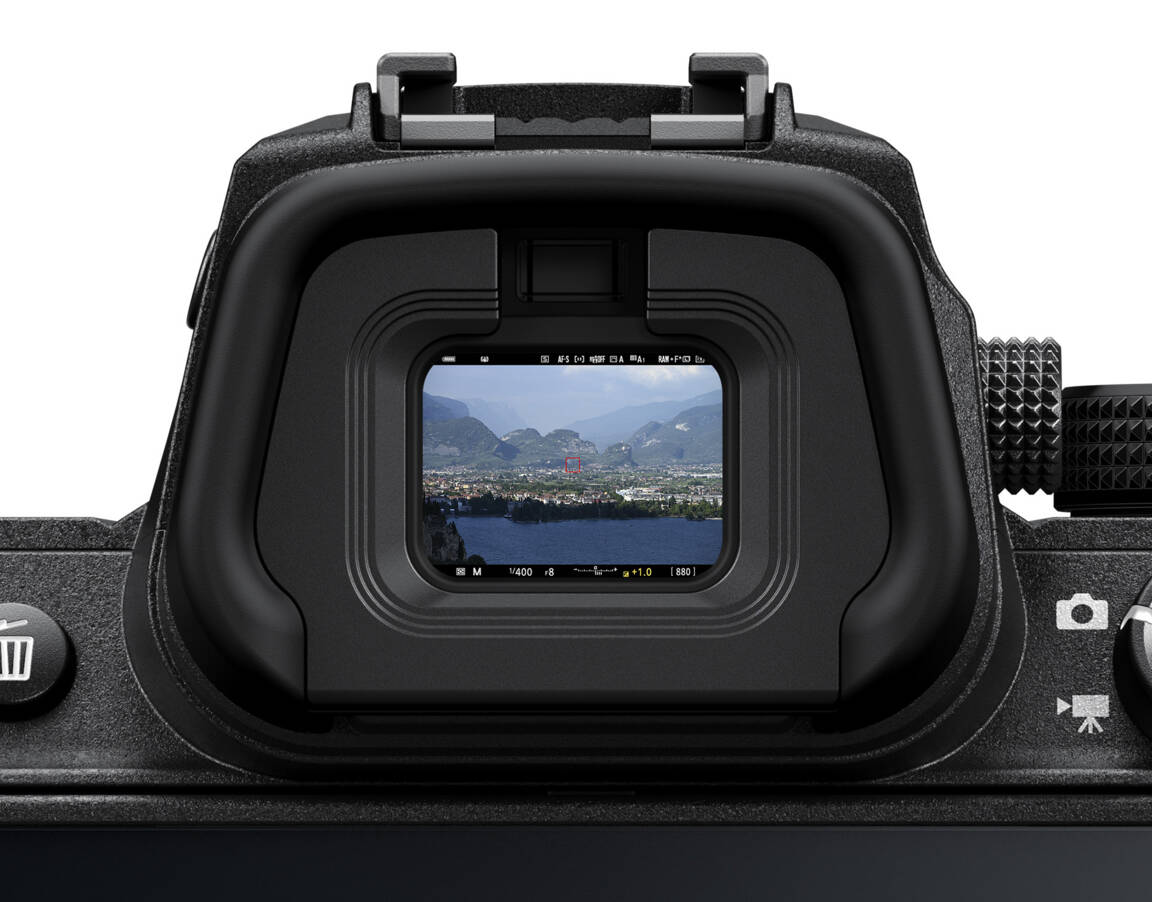
A Nikon EVF (source)
White Balance
White balance seeks to correct for color casts in an image, ensuring that white elements appear as white rather than being tinted yellow, red, or blue based on the light source. For example, fluorescent lights cast a more yellow light, so all surfaces in a space will be tinted with that yellowed light. Adjusting the white balance in your camera, or in post helps the white to appear white, and therefore remove the similar yellow cast from any of the other elements in the picture. This is typically done by selecting a section of the image that should appear as white, like a wall, a piece of paper, a shirt, or a patch of snow, and the camera or computer adjusts accordingly.
Wide-Angle Lens
Wide-angle lenses are those with short focal lengths allowing for a wider field of view. Lenses from 14 to 35mm are considered wide-angle.