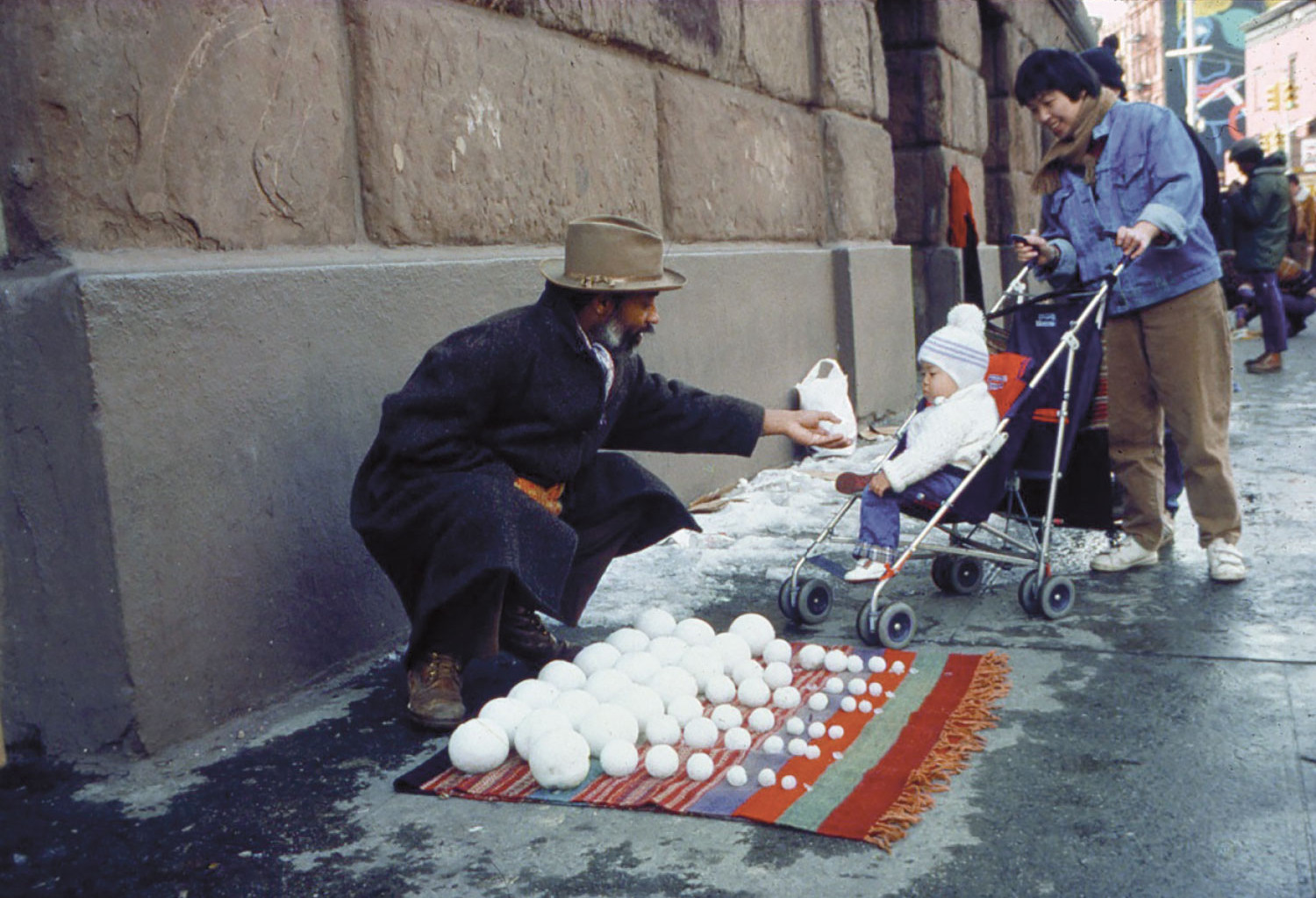
David Hammons (1943–)
Bliz-aard Ball Sale, Cooper Square, New York, 1983
Why?
You may have run across the term “conceptually grounded art.” This is not necessarily the same as Conceptual Art, which is an art movement that started in the 1960s (or 1910s depending on what you count) that de-emphasized objects and object making, and centered the concept as the nucleus of art. Although understanding Conceptual Art, can help with an understanding of conceptually grounded practices. In a nutshell, conceptually grounded art is art that is rooted in an idea, and the processes, methodologies, and materials are derived from or answer to the central idea.
Also, as you work toward your Performance Project, it can be helpful to see how Performance Art grew out of Conceptual Art. To understand much of Performance Art, it is important to understand conceptual practices and with what artists were experimenting.
Note: Due to the nature of Conceptual Art questioning boundaries and experimenting with forms and executions, some material below may be inappropriate for sensitive individuals. If you have concerns, please contact the instructor and they can guide you to material that will be suitable for you.
Required
The Case for Conceptual Art, The Art Assignment
“Sometimes art is paintings, and sometimes it's a chair. Why? Let's learn about ‘Conceptual Art,’ where the idea is more important than the form.”
John Baldessari Sings Sol LeWitt, San Francisco Museum of Modern Art
“In this clip from 1972, artist John Baldessari sings lines from Sol LeWitt's writings on conceptual art.”
Conceptual Art: An Introduction, Smarthistory
“Conceptual art constituted a dramatic departure from traditional art-making, but it did not come out of nowhere. Minimalism, the movement that directly preceded Conceptual art and the style that dominated the 1960s, conceived of art not as something internally complete and detached from the everyday world (a view that had been strongly held by the Abstract Expressionists throughout the 1950s), but rather as something that related to both its site of display as well as the viewer’s body.”
Supplementary Readings
- Conceptual Art
-
Conceptual Photography, Tate
“However, the term ‘conceptual photography’ began to be used in the 1960s, coinciding with the early explorations into video art and Conceptual Art. The phrase can refer to any use of photography within the Conceptual Art movement.”
- Eleanor Antin
- John Baldessari
-
Teaching a Plant the Alphabet
“Teaching a Plant the Alphabet is an exercise in futility, an absurdist lesson in cognition and recognition. The scenario is elementary: A small potted plant sits atop a stool. In the role of teacher, Baldessari holds up a series of children's alphabet cards in sequence, repeating each letter to the plant until he has completed the alphabet. The plant, of course, does not respond. Eliciting deadpan humor from the incongruous juxtaposition of the rote instruction and the uncomprehending pupil, Baldessari creates illogic from a logical construct, making nonsense from sense. An elaboration of working notes in which Baldessari wrote, ‘Is it worth it to teach ants the alphabet?’ this piece also responds to Joseph Beuys' 1965 performance How to Explain Pictures to a Dead Hare.” – EAI
- Sol LeWitt
-
Sentences on Conceptual Art, Conceptual Art: A Critical Anthology
These are brief treatises that explain LeWitt's view of Conceptual Art.
Response Questions
Remember to cite specific instances from the text to support your views.
- What excites you about Conceptual Art? What gives you pause? Why?
- What strains of Conceptual Art do you see in contemporary, twenty-first-century art practice?
- How might this information on Conceptual Art inform your Performance Project?