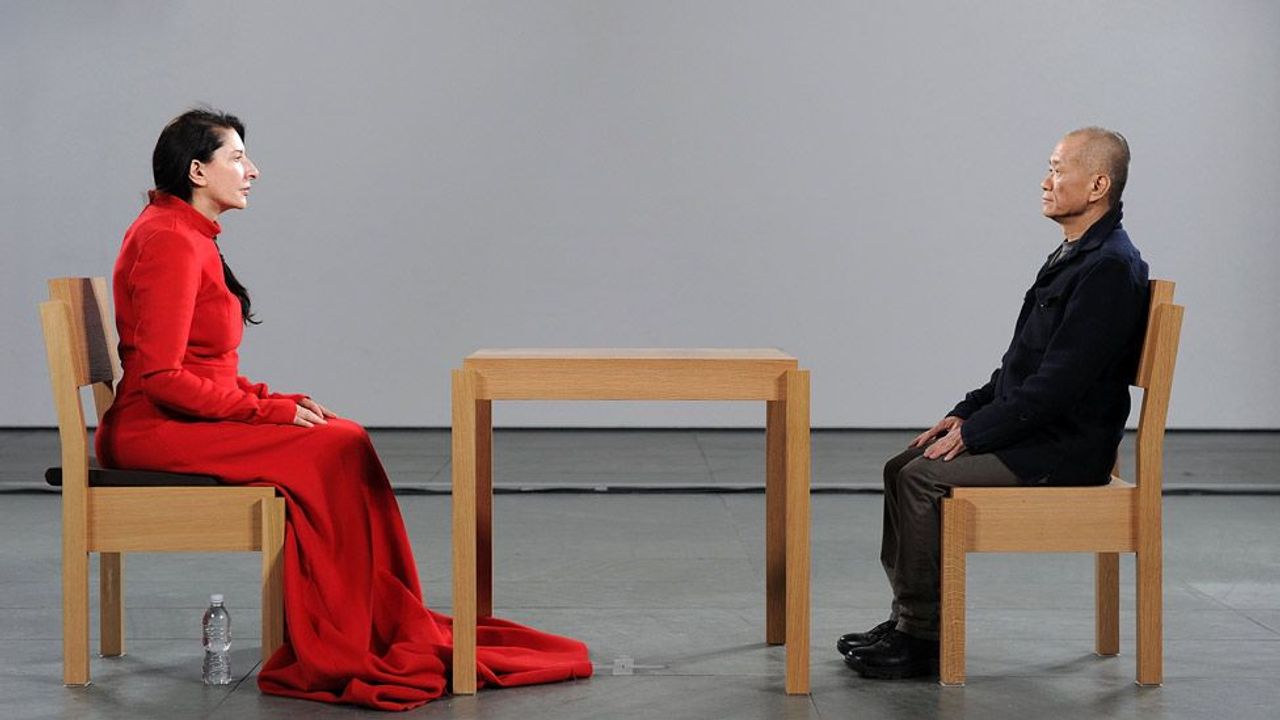
Marina Abramović
The Artist is Present, 2010
MoMA
The artist sat silently facing visitors for over 700 hours
Why?
These readings are to give you a foundation for our future discussions and work with performance art. Keep in mind that these are initial overviews of the genre and future readings will include more particulars and deeper dives into specific artists.
Performance has long been a part of visual art practices and it is difficult to extract it from experimental theater (Hugo Ball, Spalding Gray), film (Howardena Pindell, Martha Rosler), and music (Laurie Anderson, John Cage) as well as hybrid work with the plastic arts (Anne Hamilton, Senga Nengudi), since all may involve performance. Therefore, there will be overlap between performance and a number of other fields which opens up exciting possibilities. Even if you don’t work in performance art in your own practice, consider how it might play a role for you outside of just being an assignment or exercise.
To understand performance art, you actually have to see performance art. Since finding active, live performance art in Provo is unlikely, our fallback option is to watch videos of seminal performance art pieces. To really experience the performance art, you need to give yourself to it. It can be difficult since some of it is slow and difficult. Do not fast forward. Do not get distracted. Glue yourself to the screen and focus on what is happening, the gestures, the framing/angles, the artists’ choices, the pacing, all of it.
Note: Due to the nature of performance art being an exploration of the body, some material below may be inappropriate for sensitive individuals. If you have concerns, please contact the instructor and they can guide you to material that will be suitable for you.
Required
The Case for Performance Art, The Art Assignment
“Dubious of performance art? Break into a cold sweat when you realize it’s about to begin? There’s a reason. Here we present you with a brief history of performance art and attempt to sway you to its potential charms. Let us know if you buy it.”
Some Thoughts On Teaching Performance Art in Five Parts, Total Art Journal
This is an abridged version. “In the classic understanding of the medium, performance art is the act of doing. It is not representing, not recounting, not re-enacting, but simply doing. It is live and it is real. It is direct action. It is not about rehearsing a text or recreating a narrative, but rather it is an experiment with a portion of one’s life. It is not about entertainment, but about the desire to learn. Ideally, performance artists are always generating new challenges for themselves, never repeating an action. Performance is driven by curiosity, and the quest is discovery, transformation, knowledge.”
Semiotics of the Kitchen
“Semiotics of the Kitchen adopts the form of a parodic cooking demonstration in which, Rosler states, ‘An anti-Julia Child replaces the domesticated “meaning” of tools with a lexicon of rage and frustration.’ In this performance-based work, a static camera is focused on a woman in a kitchen. On a counter before her are a variety of utensils, each of which she picks up, names and proceeds to demonstrate, but with gestures that depart from the normal uses of the tool. In an ironic grammatology of sound and gesture, the woman and her implements enter and transgress the familiar system of everyday kitchen meanings—the securely understood signs of domestic industry and food production erupt into anger and violence. In this alphabet of kitchen implements, states Rosler, ‘when the woman speaks, she names her own oppression.’”
Selected Works
Includes the following documented performances:
- Fall 1, 1970 (Los Angeles)
- Fall II, 1970 (Amsterdam)
- I'm Too Sad To Tell You, 1971
- Broken Fall, 1971 (Geometric) (West Kapelle, Holland)
- Broken Fall, 1971 (Organic) (Amsterdamse Bos, Holland)
- Nightfall, 1971
Roadworks (clip)
“A lively street scene in the London borough of Brixton in the mid-1980s: people hurry along the busy streets carrying full shopping bags as they pass shabby shops and stalls. Amid all this is a young woman dressed in black walks barefoot along the dingy sidewalk. Tied to her ankles is a pair of black Dr. Martens boots, which she drags behind her, step by step. Very few people notice the young woman; some stop in amazement, shaking their heads or making fun of her display. The action, in fact, is a performance by Mona Hatoum, which the artist staged as part of an exhibition project at the Brixton Art Gallery and which she documented on video. A working-class, residential area in south London, Brixton is characterized by its multicultural population. In the 1980s, there was racist police violence against its Black residents, which led to a riot. In her performance, Mona Hatoum refers to these political events: the Dr. Martens, which she dragged through the neighborhood’s streets, were traditionally worn by the British police. Like a dark shadow, the boots seem to follow the barefoot artist, who seems naked and vulnerable. The black, lace-up Dr. Martens boots were not only part of police officers’ uniforms but were also worn by punks and skinheads. In the context of this performance, the shoes embody a system of control, violence, and oppression against which the individual is defenseless. In her video film Roadworks, Hatoum has condensed the 30-minute plus eponymous performance into a 6’45” cinematic collage that primarily focuses on the audience’s reaction.”
Paradox of Praxis 1: Sometimes Making Something Leads to Nothing
Mexico City, Mexico, 1997
Supplementary Readings
- Performance Art
- Performance Art and Documentation
- Marina Abramović
- Laurie Anderson
-
The Sensual Nature of Sound: 4 Composers: Laurie Anderson, Tania Leon, Meredith Monk, Pauline Oliveros
“The Sensual Nature of Sound portrays these New York based composer/performers in terms of their musical lives. Although all four women are pioneers in American music, each composer pursues a distinct direction of her own. Since the early 1980s, Laurie Anderson has used music and performance as the foundation for her multi-media stage shows which have since become her trademark. Cuban born Tania Leon composes orchestral music that is an intricate weave of Afro-Cuban and Latin jazz elements embedded within a classical Western concerto format. Meredith Monk experiments with new ideas in music theater and has developed a genre of opera very much her own. Pauline Oliveros draws upon the rich resources of ritual, myth, meditation, and improvisation to create a body of work that is truly visionary. Filmed at rehearsals and performances in the United States and abroad, The Sensual Nature of Sound examines the contributions of these diverse composers to contemporary American music.” - Joseph Beuys
- Chris Burden
- Fluxus and Performance
- Guillermo Gomez-Peña
- Allan Kaprow and Happenings
- Tehching Hsieh
- Senga Nengudi
- Yoko Ono
- Martha Wilson
Response Question
Remember to cite specific instances from the “readings” to support your views.
- What excites you about the prospect of doing performance art? What gives you pause?
- How might things we have discussed up to this point in the semester inform your approach to performance art?
- Where do you stand on the idea of documentation in performance art—is it a necessary evil, necessary good, unnecessary evil, or just plain unnecessary?