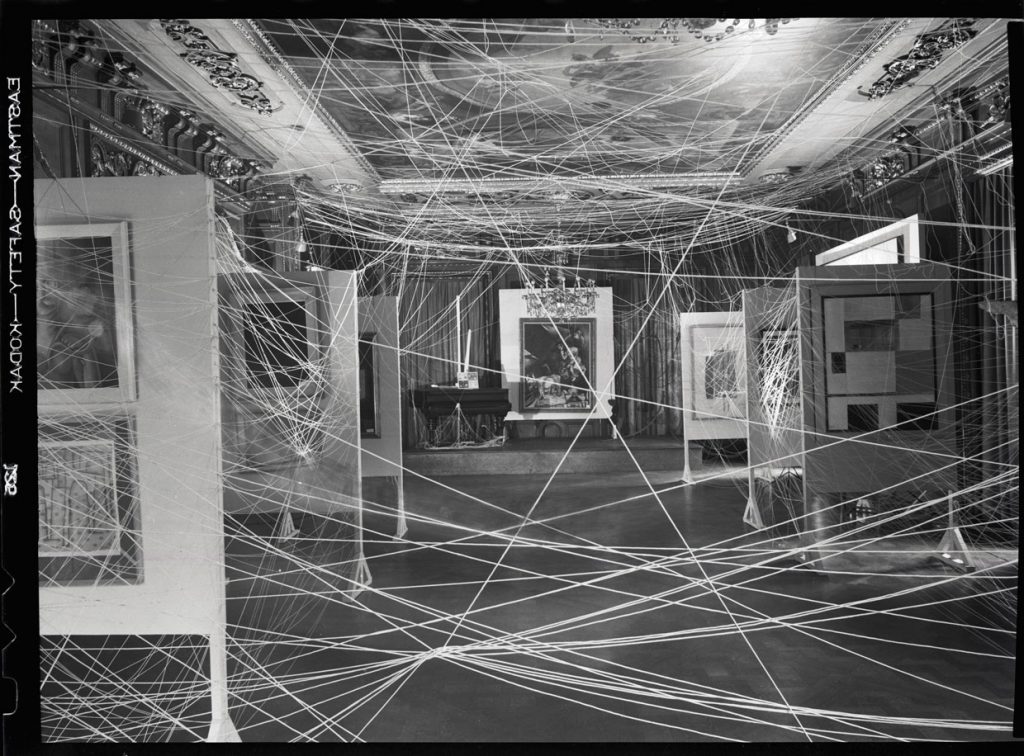
John Schiff (1907–1976)
Installation View of Exhibition ‘First Papers of Surrealism’ showing Marcel Duchamp‘s (1887–1968) String Installation, 1942
Gelatin silver print.
Philadelphia Museum of Art / Art Resource, NY
Why?
Installation Art has become a catch-all phrase for any work that takes its space into account. In that way it can be overused and lose its meaning. Diving into the origins of Installation Art can help explain how the term was initially used and how it evolved. As you learn more about Installation Art, I encourage you to look beyond just the various manifestations, but how the art form might be used to various effects—emotional, spiritual, physical, intellectual, and more.
Note: Due to the permissive nature of installation art, some material below may be inappropriate for sensitive individuals. If you have concerns, please contact the instructor and they can guide you to material that will be suitable for you.
Required
What Is___?: Installation Art, Irish Museum of Modern Art
Read both essays: “What is ___? Talks Series,” and “Here and Now: Art, Trickery, Installation”
“Installation Art is a broad term applied to a range of arts practice which involves the installation or configuration of objects in a space, where the totality of objects and space comprise the artwork. Installation Art is a mode of production and display of artwork rather than a movement or style. Installation Art can comprise traditional and non-traditional Media, such as Painting, Sculpture, Readymades, Found Objects, Drawing and Text.”
Understand Installation Art, Let's Learn About Art
“Installation Art can be daunting and confusing. Learn how to understand installation through its 4 key elements, using Olafur Eliasson's art exhibition in Singapore as a case study. Hope that you will find this video enjoyable and useful as you learn more about art.”
But Is It Installation Art?, Tate etc.
“What does the term ‘installation art’ mean? Does it apply to big dark rooms that you stumble into to watch videos? Or empty rooms in which the lights go on and off? Or chaotic spaces brimming with photocopied newspapers, books, pictures and slogans? The Serpentine Gallery announced its summer exhibition of work by Gabriel Orozco with the claim that he is ‘the leading conceptual and installation artist of his generation’—yet the show comprised paintings, sculptures and photography. Almost any arrangement of objects in a given space can now be referred to as installation art, from a conventional display of paintings to a few well-placed sculptures in a garden. It has become the catch-all description that draws attention to its staging, and as a result it’s almost totally meaningless.”
Supplementary Readings
- Installation Artists
- Installation Art History
- Interviews with Installation Artists
-
Jenny Holzer, Art21
“Jenny Holzer’s history as a typesetter feels obvious, once you’re acquainted with her signature text-based artworks. From PROTECT PROTECT at the Museum of Contemporary Art, Chicago, Holzer recounts her fondness for programming the LED electronics that display her statements. Within the programming process, Holzer curates the speed of the revolving message, and orchestrates the pauses and flashes of the phrase. The emission of light by the LEDs is affected by each of these variables, simultaneously influencing the mood and energy of the exhibition space.”
Writing & Difficulty: Jenny Holzer, Art21
“Jenny Holzer discusses her difficult relationship to writing during the installation of the exhibition PROTECT PROTECT at the Museum of Contemporary Art, Chicago. ‘I have no idea whether I’ll write again,’ says Holzer. ‘One reason why I left it is because I tend to write about the most ghastly subjects. So it’s not just the difficulty in having something turn out right, it’s the difficulty of staying with the material long enough to complete it.’While multiple factors have contributed to Holzer’s writing hiatus, her body of work remains as poignant and provocative as ever. Whether questioning capitalist impulses, or describing torture, Holzer’s art expresses concepts and questions through subversive lightworks which present her queries through projections or streamlined LED marquis. ‘My work might be like theater in that I hope there’s an audience,’ says the artist.”
Theaster Gates: Collecting, Art21
“Theaster Gates creates sculptures with clay, tar, and renovated buildings, transforming the raw material of urban neighborhoods into radically reimagined vessels of opportunity for the community. Establishing a virtuous circle between fine art and social progress, Gates strips dilapidated buildings of their components, transforming those elements into sculptures that act as bonds or investments, the proceeds of which are used to finance the rehabilitation of entire city blocks. Many of the artist’s works evoke his African-American identity and the broader struggle for civil rights, from sculptures incorporating fire hoses, to events organized around soul food, and choral performances by the experimental musical ensemble Black Monks of Mississippi, led by Gates himself.”
Theaster Gates in “Chicago”, Art21
“Theaster Gates first encountered creativity in the music of Black churches on his journey to becoming an urban planner, potter, and artist. Gates creates sculptures out of clay, tar, and renovated buildings, transforming the raw material of the South Side into radically reimagined vessels of opportunity for the community.”
Postcommodity in “Borderlands”, Art21
“The interdisciplinary collective Postcommodity creates site-specific installations and interventions that critically examine our modern-day institutions and systems through the history and perspectives of Indigenous people. Influenced by growing up in the southwestern United States, the artists Cristóbal Martínez and Kade L. Twist revisit their 2015 public installation, ‘Repellent Fence,’ produced with previous Postcommodity artist, Raven Chacon. A two-mile-long line of enormous balloons across the Arizona-Sonora border, “Repellent Fence’ symbolically sutured together cultures and lands that had been unified long before borders were drawn. To examine our cultural institutions and their demographic future, the pair thinks of the coming decades, when the U.S. Census Bureau predicts a non-White majority. ‘Our job is to allow a new public memory to be born,’ says Martínez. ‘Here’s our lens; take a look at the world through it, and tell us what you think.’”
Judy Pfaff in “Romance”, Art21
“Balancing intense planning with improvisational decision-making, Judy Pfaff creates exuberant, sprawling sculptures and installations that weave landscape, architecture, and synthetic color into a tense yet organic whole. Judy Pfaff was born in London, England, in 1946.”
Ann Hamilton in “Spirituality”, Art21
“Whether working with sculpture, textiles, film, and sound, or even her unique mouth-operated pinhole cameras, Ann Hamilton finds all her art to be about a ‘very fundamental act of making.’ Ann Hamilton was born in 1956 in Lima, Ohio.”
Ann Hamilton: “the event of a thread”, Art21
“From Manhattan's Park Avenue Armory, artist Ann Hamilton discusses her installation, "the event of a thread" (2012), which occupied the Armory's cavernous drill hall. Hamilton, whose artwork often deals with the connection between text and textiles, was present at the Armory every day during the installation's one-month run. During that time she was able to witness the various ways visitors chose to engage with the different though interconnected elements of the artwork. ‘It's very intimate, and yet, it's very large and anonymous—this quality of solitude and being in a congregation or group of people,’ says Hamilton. ‘The feeling of that is actually very comforting, and something that we need.’ Ann Hamilton's work is a unique blend of performance, photography, video, textiles, and sculpture. Best known for her sensual, environmental installations, Hamilton's work often combine sensory elements of sound, taste, smell and touch. She is as interested in verbal and written language as she is in the visual, and sees the two as related and mutable elements.”
Wolfgang Laib in “Legacy”, Art21
“Inspired by the teachings of Laotzi, by the modern artist Brancusi, and by formative experiences with his family in Germany and India, Wolfgang Laib’s sculptures seem to connect the past and present, the ephemeral and eternal. His attention to human scale, duration of time, and his choice of materials give his works the power to transport us to unexpected realms of memory, sensory pleasure, and contemplation.”
- Other Installation Art Examples
- Installation Art: How to Make Money?
-
Making money as an INSTALLATION artist HOW-TO guide!, Spark Box Studio Printshop & Artist Residency
“It may seem impossible to make a living as an installation artist because … what exactly are you ‘selling’? An experience. An environment. A transformative space. A community building opportunity. In this episode of Art Discourse we answer the question: ‘How do installation artists make money from their art?’ We discuss NINE different ways you can get paid for your installation art. From granting to arts festivals there are so many different ways installation artists can get paid for their immersive work! We’ll be honest, when we first started making installation artwork we didn’t have a clue what the possibilities were. We still don’t know all of them. But after creating installations almost 5 years now we’ve found that they are a blast to create and often well funded.”
Response Question
Remember to cite specific instances from the “readings” to support your views.
- What excites you about the prospect of doing installation art? What gives you pause?
- How might things we have discussed up to this point in the semester inform your approach to installation art?