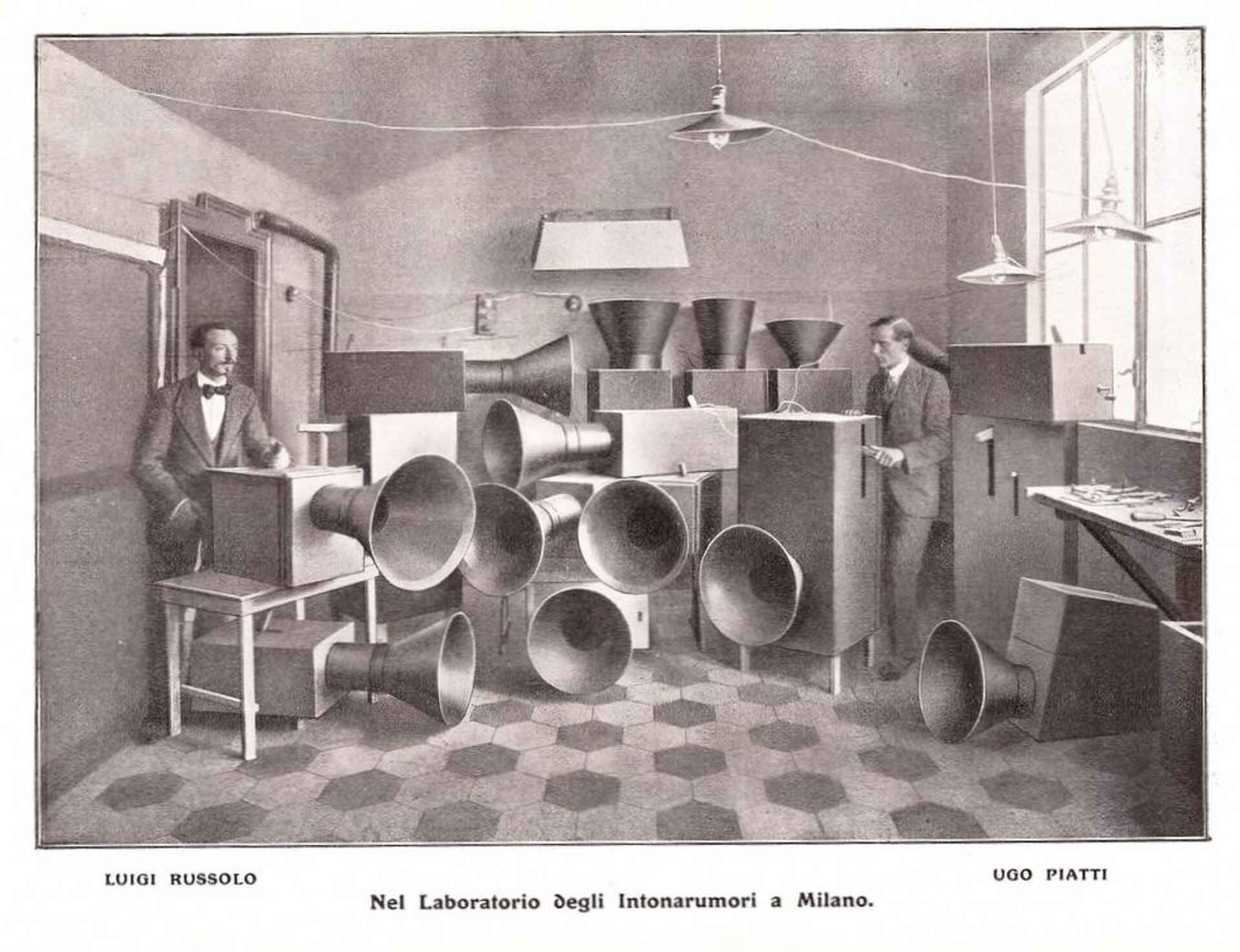
Noise Instruments by Luigi Russolo for brutalist music, 1913.
Why?
New Genres is a tricky category in which to place art, and its even trickier when we consider the disciplines and type of work that is placed within that category. Sound within art (apart from music and theatre) has been a fixture since the early twentieth century. Performance art is either over one hundred years old or over fifty years old, depending on what you count. Video art has existed for almost sixty years. Installation art has existed for over a century. None of these are particularly “new” except in relation to thousands of years of cultural production. What is important to focus on is not necessarily the associated mediums, but the impetus and ethos that is associated with newer art. The Calvino text in the readings below is meant to address the desire to create something new, to copy things that are new, and to refine and explore the things that are made.
We are starting our foray into new genres with sound. This is partly because it is not typically focused on in standard art education, therefore opens up a lot of possibilities without prejudice.
Required
A Sign in Space, Cosmicomics
- “Cosmicomics,” Wikipedia, last updated January 10, 2025, accessed August 20, 2025, https://www.wikiwand.com/en/articles/Cosmicomics.
A Brief History of Sound Art, Barnes Foundation
Supplementary Readings
- New Genres
-
Introduction, Mapping the Terrain: New Genre Public Art
“For the past three or so decades visual artists of varying backgrounds and perspectives have been working in a manner that resembles political and social activity but is distinguished by its aesthetic sensibility. Dealing with some of the most profound issues of our time—toxic waste, race relations, homelessness, aging, gang warfare, and cultural identity—a group of visual artists has developed distinct models for an art whose public strategies of engagement are an important part of its aesthetic language. The source of these artworks’ structure is not exclusively visual or political information, but rather an internal necessity perceived by the artist in collaboration with his or her audience. We might describe this as ‘new genre public art,’ to distinguish it in both form and intention from what has been called ‘public art’—a term used for the past twenty-five years to describe sculpture and installations sited in public places. ”Transgressing Boundaries (Even Those Marked Out by the Predecessors) in New Genre Conceptual Art, Art After Conceptual Art
“Tracing the difficulties that prevsous gencrations of Conceptual art coming from behind the Iron Curtain faced while seeking broader recognition, we can acknowledge that any art with latent or explicit political connotations was not readily accepted by Conceptual art in general (that is, by the North American canon of hard-core Conceptualism).” - History of Sound Art
-
History of Sound Art: Audio
“An engaging sound collage presenting an unique historical documentation of a century of Sound Art from the early 20th century to 20011.
“The composition weaves through different sound works throughout the century with narratives and ideas from some of the prominent artists in the field. A retrospective into the craft of sound and its development as an artistic practice, from Edison’s first sound film in 1895 to today, including the thoughts and concepts which served the basis for the creation of these works as spoken by the artists themselves.
T“he ‘Listening’ can be accompanied with the booklet available here that informs of the artists whose work and words are heard according to the timecode on the video.
“Commissioned by Newtoy Ltd in 2011. Created by J Milo Taylor. Mixed by Joel Cahen
“Featuring:
Sleep Research Facility, Cathy Lane, John Cage, Charlie Fox, Ros Bandt, Janet Cardiff, Brandon La Belle, Thomas Edison, Marcel Duschamp, Hugo Ball, Leon Theramin, FW Marinetti, Walter Ruttmann, Kurt Schwitters, Harry Partch, Antonin Artaud, Pierre Schaeffer and Pierre Henry, Iannis Xenakis, Louis and Bebe Barron, Pauline Oliveros, Morton Feldman, George Brecht, Richard Maxfield, Dick Higgins, Group Ongaku, Brion Gysin, Karlheinz Stockhausen, Tod Dockstader, La Monte Young, Luc Ferrari, Alvin Lucier, Bruce Nauman, Bernard Parmegiani, Francoise Bayle, R Murray Schafer, Trevor Wishart, hildegard Westerkamp, Terry Fox, David Dunn, Nam June Paik, Max Neuhaus, Throbbing Gristle, Barry Truax, Limpe Fuchs, John Oswald, Bill Fontana, Warren Burt, David Cunningham, Laurie Anderson, Gregory Whitehead, Lee Renaldo, Christian Marclay, William Burroughs, Denis Smalley, Dan Lander, Gilles Gobeil, Negativland, Trimpin, Jonty Harrison, Kim Cascone, Jodi Rose, Francisco Lopez, Bernard Leitner, Peter Vogel, Steve Roden, Pamela Z, Terre Thaemlitz, Chris Watson, David Toop, Disinformation, Atau tanaka, Dan Lander, Philip Jeck, Carsten Nicolai, Justin Bennett, David Toop, Project Dark, Steve Vitiello, Maryanne Amacher, Christina Kubisch, John Bischoff, Andres Bosshard, Iris Garrelfs, Peter Cusack, Steve Barsotti, Andrea Polli, James Webb, Nic Collins, DJ Spooky, Rainer Linz, Salomé Voegelin, David Lee Myers, David Chesworth and Sonia Leiber, Karlheinz Essl, Dallas Simpson, FM3, Matthew Mullane, Ultra-Red, Tony Herrington, Dan Senn, John Wynne and Susan Philipsz.”History of Sound Art: Timeline
This timeline accompanies J. Milo Taylor's “engaging sound collage presenting an unique historical documentation of a century of Sound Art from the early 20th century to 2011." You can also see the entire timeline as a scrollable, single-page PDF: https://www.dropbox.com/scl/fi/dkbnw9ej90kltp0kl51j2/taylor_history-of-sound-art-vertical.pdf?rlkey=t60n33yn5nkts7eds0130ql96&st=mbibe8xa&dl=0A Brief History of Sound Art, Berman Museum of Art
“Can sound be an artistic medium? Absolutely! This video details the history of sound art--when the term became popularized and the historical precedent for this contemporary mode of art making.” - Sound Artists
-
Sound Artists: A List
This is a spreadsheet listing sound artists along with links to help with further research. - Pauline Oliveros
-
The Sensual Nature of Sound: 4 Composers: Laurie Anderson, Tania Leon, Meredith Monk, Pauline Oliveros
“The Sensual Nature of Sound portrays these New York based composer/performers in terms of their musical lives. Although all four women are pioneers in American music, each composer pursues a distinct direction of her own. Since the early 1980s, Laurie Anderson has used music and performance as the foundation for her multi-media stage shows which have since become her trademark. Cuban born Tania Leon composes orchestral music that is an intricate weave of Afro-Cuban and Latin jazz elements embedded within a classical Western concerto format. Meredith Monk experiments with new ideas in music theater and has developed a genre of opera very much her own. Pauline Oliveros draws upon the rich resources of ritual, myth, meditation, and improvisation to create a body of work that is truly visionary. Filmed at rehearsals and performances in the United States and abroad, The Sensual Nature of Sound examines the contributions of these diverse composers to contemporary American music.”Pauline Oliveros, Sonosphere
“This episode of Sonosphere takes a look at the life and work of composer Pauline Oliveros through the eyes and ears of those who worked with her and learned from her. We spoke with Claire Chase, Wu Fei, Monique Buzzarte, Tara Rodgers, and Kerry O'Brien about how Pauline touched their lives personally and professionally, and how her legacy shaped the musical world of today.”KQED Spark: Pauline Oliveros, KQED
“Spark makes acquaintance with Pauline Oliveros, the internationally renowned pioneer in electronic and improvisational music. Original air date: February 2004.”The Difference Between Hearing and Listening | Pauline Oliveros | TEDxIndianapolis, TEDx Talks
“Sounds carry intelligence. If you are too narrow in your awareness of sounds, you are likely to be disconnected from your environment. Ears do not listen to sounds; the brain does. Listening is a lifetime practice that depends on accumulated experiences with sound; it can be focused to detail or open to the entire field of sound. Octogenarian composer and sound art pioneer Pauline Oliveros describes the sound experiment that led her to found an institute related to Deep Listening, and develop it as a theory relevant to music, psychology, and our collective quality of life. Pauline is a composer and accordionist who significantly contributed to the development of electronic music. The culmination of her life-long fascination with music and sound is what inspired the practice of Deep Listening, the art of listening and responding to environmental conditions. As a Professor of Practice in the Arts Department at Rensselaer Polytechnic Institute, she produced highly regarded work as a composer and improviser. Pauline’s 1989 recording, Deep Listening, is considered a classic in her field.”Pauline Oliveros on The Power of Listening | Red Bull Music Academy, Red Bull Music Academy
“Pioneering artist Pauline Oliveros recalled how she created her own instruments and how listening can help change how you hear in her 2016 Red Bull Music Academy lecture.” - Listening
-
Pauline Oliveros, Sonosphere
“This episode of Sonosphere takes a look at the life and work of composer Pauline Oliveros through the eyes and ears of those who worked with her and learned from her. We spoke with Claire Chase, Wu Fei, Monique Buzzarte, Tara Rodgers, and Kerry O'Brien about how Pauline touched their lives personally and professionally, and how her legacy shaped the musical world of today.”The Difference Between Hearing and Listening | Pauline Oliveros | TEDxIndianapolis, TEDx Talks
“Sounds carry intelligence. If you are too narrow in your awareness of sounds, you are likely to be disconnected from your environment. Ears do not listen to sounds; the brain does. Listening is a lifetime practice that depends on accumulated experiences with sound; it can be focused to detail or open to the entire field of sound. Octogenarian composer and sound art pioneer Pauline Oliveros describes the sound experiment that led her to found an institute related to Deep Listening, and develop it as a theory relevant to music, psychology, and our collective quality of life. Pauline is a composer and accordionist who significantly contributed to the development of electronic music. The culmination of her life-long fascination with music and sound is what inspired the practice of Deep Listening, the art of listening and responding to environmental conditions. As a Professor of Practice in the Arts Department at Rensselaer Polytechnic Institute, she produced highly regarded work as a composer and improviser. Pauline’s 1989 recording, Deep Listening, is considered a classic in her field.”Pauline Oliveros on The Power of Listening | Red Bull Music Academy, Red Bull Music Academy
“Pioneering artist Pauline Oliveros recalled how she created her own instruments and how listening can help change how you hear in her 2016 Red Bull Music Academy lecture.”
Response Questions
Remember to cite specific instances from the text to support your views.
- What are the pros and cons of the drive to explore the “new?”
- Which artists/projects mentioned resonated with you and why?
- What excites you about or causes you to hesitate when it comes to making your own sound art given what was mentioned in the readings?